
Karex, the Malaysian company that makes roughly one in five of the world's condoms -- about five billion a year, supplying Durex and Trojan among others -- announced this week that it is raising prices by up to 30 percent. The reason is the Strait of Hormuz.

Dhankhar said every word spoken by a constitutional functionary is guided by the supreme sublime interest of the nation.

The Supreme Court is examining the extent to which courts can intervene when governors delay or refuse to act on bills passed by state assemblies. The court questioned the Centre on whether judicial review is barred in cases of gubernatorial inaction, sparking debate on the balance of power between states and the central government.

Parliamentary Affairs Minister Kiren Rijiju feels that the National Sports Governance Bill, which is set to be tabled in the monsoon session beginning on Monday, will usher in a 'new era' for sports in India.

Finance Minister Nirmala Sitharaman announces increased domestic LPG production to offset import disruptions caused by Middle East tensions, alongside assurances of fertiliser availability and the clearing of UPA-era oil bonds.

The winter session of Parliament is set to begin with the government prioritizing its reforms agenda, including a bill to open the civil nuclear sector to private players. The opposition is expected to raise concerns about electoral roll revisions and air pollution.

Salient features of the National Sports Governance Bill that promise to overhaul several aspects of sports governance and the grievance redressal system for athletes and administrators alike in the country.

While it is expected that the JD-U, a major ally of the Bharatiya Janata Party, will support the Waqf Bill, two JD-U MPs, Union Minister Lalan Singh and party Working President Sanjay Jha met Union Home Minister Amit Shah in Delhi on Tuesday.

The inaugural Khelo India Tribal Games (KITG) commenced in Chhattisgarh, providing a national stage for tribal athletes to showcase their abilities. Union Sports Minister Mansukh Mandaviya highlighted the event's significance in promoting sports culture and identifying talent from remote areas.
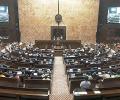
President Droupadi Murmu has given her assent to the Waqf (Amendment) Bill, 2025, which has sparked controversy and legal challenges. The Bill, passed by Parliament after heated debates, has been criticized by opposition parties as "anti-Muslim" and "unconstitutional". The government, however, maintains that the reform will benefit the Muslim community. Several petitions have been filed in the Supreme Court challenging the constitutional validity of the Bill, alleging discrimination against Muslims and undermining their religious autonomy. The Bill repeals the Mussalman Wakf Act, 1923, and introduces restrictions on Waqf properties and their management, which have raised concerns about the impact on the Muslim community.

'In consultations, several stakeholders, including athlete representatives and smaller federations, highlighted that overly restrictive eligibility rules tended to entrench incumbents and limit opportunities for fresh leadership.'
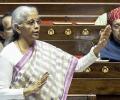
Union Finance Minister Nirmala Sitharaman on Thursday lashed out at TMC MP Saugata Roy for objecting to her speaking in Hindi on a bill, pointing out that the translation technology allows members to listen to speeches in any language.

Officials said the government is keen to conform to the convention of the Union Budget for 2026-2027 being presented on February 1 despite it falling on a Sunday in 2026.

The central government will have the power to "impose reasonable restrictions" on the international participation of Indian teams and individual athletes under "extraordinary circumstances", as per the National Sports Governance Bill that was tabled in Lok Sabha on Wednesday.

The Bill is likely to pave the way for amending two existing legislations -- the Atomic Energy Act 1962, and the Civil Liability for Nuclear Damage Act 2010.
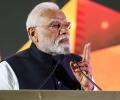
Prime Minister Narendra Modi hailed the passage of the Waqf (Amendment) Bill in Parliament as a "watershed moment" in the country's quest for socio-economic justice, transparency and inclusive growth. He said the legislation will particularly help those who have long remained on the margins, thus being denied both voice and opportunity. Modi stated that the Waqf system was synonymous with lack of transparency and accountability, especially harming Muslim women, poor Muslims and Pasmanda Muslims. He added that the legislation will boost transparency and safeguard people's rights, ushering in a more modern and socially just framework. The prime minister thanked all members of Parliament and the public for their contributions to the legislation.

The core issues to be settled -- access to Hormuz, Israel's aggression in Lebanon, the question of Iran's nuclear programme, sanctions relief and compensation -- are thorny enough to require weeks of patient negotiation. The most likely outcome of the opening sessions is that both sides take the measure of each other, establish what is and is not negotiable, and return home without having broken anything. That would count as progress.

The Indian government has introduced a bill in the Lok Sabha to ban online games played with money, aiming to curb addiction, money laundering, and financial fraud. The bill also targets advertisements and financial transactions related to such games.
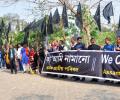
The Supreme Court has announced it will begin final hearings on May 5 regarding the constitutional validity of the Citizenship (Amendment) Act, 2019 (CAA), with over 200 petitions challenging the law.
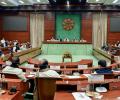
Opposition parties in India are demanding a discussion on the Special Intensive Revision (SIR) of electoral rolls and national security in the upcoming Winter Session of Parliament. They raised concerns about federalism, national security, and the purity of voter lists during an all-party meeting.

The government has circulated among members ofParliament a new draft of the Amendment of Insurance laws Bill, 2025, proposing stricter safeguards on the utilisation of life insurance funds and other specified insurance business funds, particularly for dividend payouts, bonuses, and servicing of debentures.

The Infinite Saree campaign is using India's most iconic garment to demand a law against marital rape in the country.
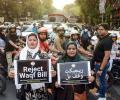
The Congress party announced its intention to challenge the constitutionality of the recently passed Wakf (Amendment) Bill, 2024 in the Supreme Court. AICC general secretary Jairam Ramesh stated that the party will "very soon" file a petition, citing concerns about the bill's impact on constitutional principles. Ramesh highlighted the Congress's ongoing legal challenges against other legislation, including the Citizenship Amendment Act (CAA), amendments to the Right to Information (RTI) Act, and changes to the Conduct of Election Rules. He emphasized the party's commitment to defending the Constitution's principles, provisions, and practices.
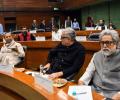
India's Parliament is set to begin its Budget session on Friday, with opposition parties poised to demand a discussion on the alleged mismanagement of the Maha Kumbh festival in Prayagraj, where 30 pilgrims died in a stampede. The opposition also accused the government of politicising parliamentary committees and pushing its agenda through its majority. The session will start with President Droupadi Murmu addressing both houses of Parliament. Finance Minister Nirmala Sitharaman will present the Union Budget on Saturday for the eighth consecutive time.

A leading Catholic Church daily in Kerala has described the Waqf amendment bill as a crucial test of secularism in Parliament, urging MPs to support it. The editorial in Deepika daily comes as the union government prepares to table the bill for parliamentary consideration. The editorial calls the bill a test of secularism and warns MPs that failing to support it would mark them in history as endorsing religious fundamentalism. The paper added that the bill will also put an end to the injustices faced by thousands of Hindu, Christian, and Muslim citizens who have suffered due to the Waqf law. The editorial also recalled the recent statement addressed to Kerala MPs by Kerala Catholic Bishops' Council (KCBC) where the KCBC President Cardinal Mar Baselios Cleemis Catholicos urged amending provisions in the Waqf law that validate claims over land which people of Munambam have lawfully possessed. Opposition parties have slammed the bill as "unconstitutional" and against the interest of the Muslim community.
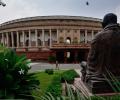
The session is likely to see the proceedings of Parliament move from the old building to the new Parliament building.

Civil society groups, led by the NREGA Sangharsh Morcha, are planning a nationwide protest -- similar to the farmers' stir a few years ago -- starting December 19 demanding scrapping of the new Viksit Bharat-Guarantee for Rozgar and Aajeevika Mission.

President Droupadi Murmu has given her assent to the Viksit Bharat Guarantee for Rozgar and Ajeevika Mission (Gramin) Bill, which aims to replace MGNREGA and guarantee 125 days of wage employment per rural household.

'When the Bill was passed all have been exposed. There is no difference between communal and secular.'
Once more women assume leadership roles and join the nation-building process, he said, adding they will become a guarantee of the country's bright future.
'It is not as if Hindus are not being touched at all, and only Muslims are.'

Kharge condemned the use of the "abodh balak" term for Gandhi and alleged that BJP MPs can't even speak their mind.
The Supreme Court has sought the Centre's response on a plea seeking the implementation of the 2023 Nari Shakti Vandan Act, which reserves one-third of seats for women in the Lok Sabha and state assemblies.

National Conference president Farooq Abdullah stated that displaced Kashmiri Pandits are welcome to return to their homes in the Valley, but expressed doubt that they would want to return permanently.

'Even if it is defeated and the Speaker remains, the Opposition parties that have lost faith in his impartiality will continue to have that feeling.' 'If the Speaker reflects on this and tries to be more neutral, more impartial, more objective in his conduct -- then one can say the resolution had a salutary effect. That would be the best outcome.'
Parliament's approval of the Waqf (Amendment) Bill, a contentious piece of legislation aimed at reforming Waqf bodies, has sparked strong reactions from the opposition, who allege that the bill was "bulldozed" through Parliament. The bill, considered the government's most consequential legislation in its third term, was passed with comfortable majorities in both the Lok Sabha and Rajya Sabha despite opposition claims of a lack of consultation and an intrusion into religious affairs. Other notable bills approved during the session included the Finance Bill, Appropriation Bill, Immigration and Foreigners Bill, and Tribhuvan Sahkari University Bill. The session, which saw high productivity, also witnessed debates on issues such as economic distress, delimitation, and the three-language policy. While the government touted its achievements, the opposition criticized the government's approach and vowed to challenge the Waqf bill in court.

Finance Minister Nirmala Sitharaman on Tuesday participated in a traditional 'halwa' ceremony, marking the final stage for the preparation of the Union Budget 2026-27, to be unveiled on February 1 in the Lok Sabha.

The joint committee of Parliament examining the Waqf (Amendment) Bill submitted its report to Lok Sabha Speaker Om Birla on Thursday. The panel adopted the report by a majority vote, with changes suggested by members of the ruling BJP. Opposition members, who submitted dissent notes, called the exercise an attempt to destroy Waqf boards and termed the bill an attack on the constitutional rights of the Muslim community.
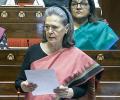
Congress Parliamentary Party chairperson Sonia Gandhi has criticized the Waqf (Amendment) Bill, calling it a 'brazen assault' on the Constitution and part of the BJP's strategy to keep society in a 'permanent state of polarization.' She also spoke out against the One Nation, One Election Bill, calling it a 'subversion of the Constitution.' Gandhi further accused the Modi government of ignoring the women's reservation bill and other demands for reservation, and of 'dragging the country into an abyss' where the Constitution will only exist on paper. She also criticized the government for limiting the speaking time of the Leader of the Opposition in Parliament and for not allowing discussions on important issues like the working of the defense and external affairs ministries and the challenges posed by China on the border.
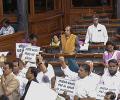
The monsoon session of Parliament which saw many disruptions since it began on July 20 over the Manipur violence issue, is set to become more turbulent with the government likely to introduce a bill in the Lok Sabha to replace the Delhi services ordinance.
